
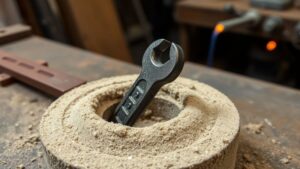
Consumer 3D printers are great for plastic prototypes. They are not great for tools that need to handle real torque. That gap is exactly what one maker decided to close — by converting a 3D-printed form into a fully functional cast iron wrench using a microwave.
The project, highlighted by Hackaday, challenges the assumption that metal casting requires a full foundry setup. It doesn’t — at least not for small, precise parts.
3D Printing as a Casting Pattern, Not the Final Part
The core insight here is simple but effective: the 3D print is never meant to be the finished tool. It’s a sacrificial pattern. According to Hackaday’s coverage of the build by [Shake the Future], the printed form is used to create a mold, which is then fired in a microwave kiln to burn out the plastic and cure the surrounding casting material.
This approach borrows from lost-PLA casting — a technique where a plastic positive is destroyed in the process of creating a metal negative. The microwave accelerates the burnout and sintering steps that would normally require a dedicated kiln running for hours.
Why Cast Iron Specifically?
Cast iron is dense, hard, and holds its shape under compression. For a wrench — a tool that transmits rotational force to fasteners — those properties matter far more than tensile flexibility. PLA or PETG simply cannot sustain that kind of mechanical load without cracking or deforming over time.
The trade-off is brittleness. Cast iron can fracture under sudden impact rather than bending. For a wrench used with steady, controlled force, that’s an acceptable limitation. For a hammer or pry bar, less so.
The Microwave Kiln Method: What’s Actually Happening
A standard kitchen microwave won’t do this. The process uses a microwave kiln — a small refractory container that absorbs microwave energy and converts it to radiant heat, reaching temperatures high enough to fire ceramic mold material and burn out organic binders.
The sequence, as described in the Hackaday piece, involves:
- 3D printing the wrench geometry in a burnable filament (typically PLA)
- Embedding the print in an investment casting powder or refractory mix
- Running the microwave kiln to burn out the plastic and cure the mold
- Pouring molten cast iron into the resulting cavity
- Breaking away the mold to reveal the metal part
The entire cycle is dramatically shorter than traditional foundry work. That’s not nothing for a home workshop setup.
Precision Limits to Keep in Mind
Investment casting from 3D-printed patterns can hold reasonable dimensional tolerances, but cast iron shrinks as it cools — typically around 1% volumetrically. For a wrench jaw that needs to fit a specific fastener size, that shrinkage must be accounted for in the original print dimensions. Miss it, and the wrench won’t fit a standard hex head.
Who Actually Benefits From This Process?
Fair enough — most people don’t need to cast their own wrenches. But this technique opens something real for a specific audience:
- Makers and prototypers who need one-off metal tools without CNC machining costs
- Repair shops in low-supply environments where sourcing a specific tool size isn’t practical
- Educators demonstrating metal casting and materials science without industrial equipment
- Preppers and off-grid builders who want to manufacture replacement hardware from raw materials
The build also connects thematically to a broader Hackaday feature on resilience-focused hardware — including a “bug out bike” designed for infrastructure-down scenarios. Both projects share the same underlying philosophy: reduce dependency on supply chains by building fabrication capability into your own shop.
What This Means for DIY Metal Fabrication
The accessibility of investment casting is improving fast. Microwave kilns cost under $50. PLA filament is ubiquitous. The real bottleneck — melting cast iron — still requires a crucible furnace reaching roughly 1,200°C, which is not a casual weekend project. Aluminum, with a melting point around 660°C, is a more realistic starting point for most home casters.
Still, the proof-of-concept is solid. A functional cast iron wrench produced from a $200 printer and a microwave kiln is a meaningful data point about where accessible fabrication is heading. The process isn’t fast or foolproof, but it works — and the failure modes are predictable enough to design around.
Whether this replaces buying a wrench at a hardware store is beside the point. The value is in the capability itself.
Q: Can any 3D printer filament be used for lost-PLA casting?
A: PLA is the most common choice because it burns out cleanly at relatively low temperatures. ABS and PETG leave more residue and can crack the mold during burnout. Wax-based filaments designed specifically for investment casting also exist but are less widely available.
Q: Is a microwave kiln hot enough to melt cast iron?
A: No. Microwave kilns are used to fire the mold and burn out the plastic pattern — not to melt the iron. Cast iron requires a separate crucible furnace to reach its melting point. The microwave handles mold preparation only.
Q: How accurate is a cast iron part made from a 3D-printed pattern?
A: Tolerances depend on the casting powder, burnout quality, and shrinkage compensation built into the design. For non-precision parts, results can be quite good. For tools requiring tight dimensional fits — like wrench jaws — the print must be scaled up slightly to account for metal shrinkage during cooling.
A Special Thanks
This comprehensive analysis was synthesized using reporting from hackaday.com.
To dive deeper, please explore the primary sources below: